
How Real-Time Flight Tracking Works in Professional Limo Services
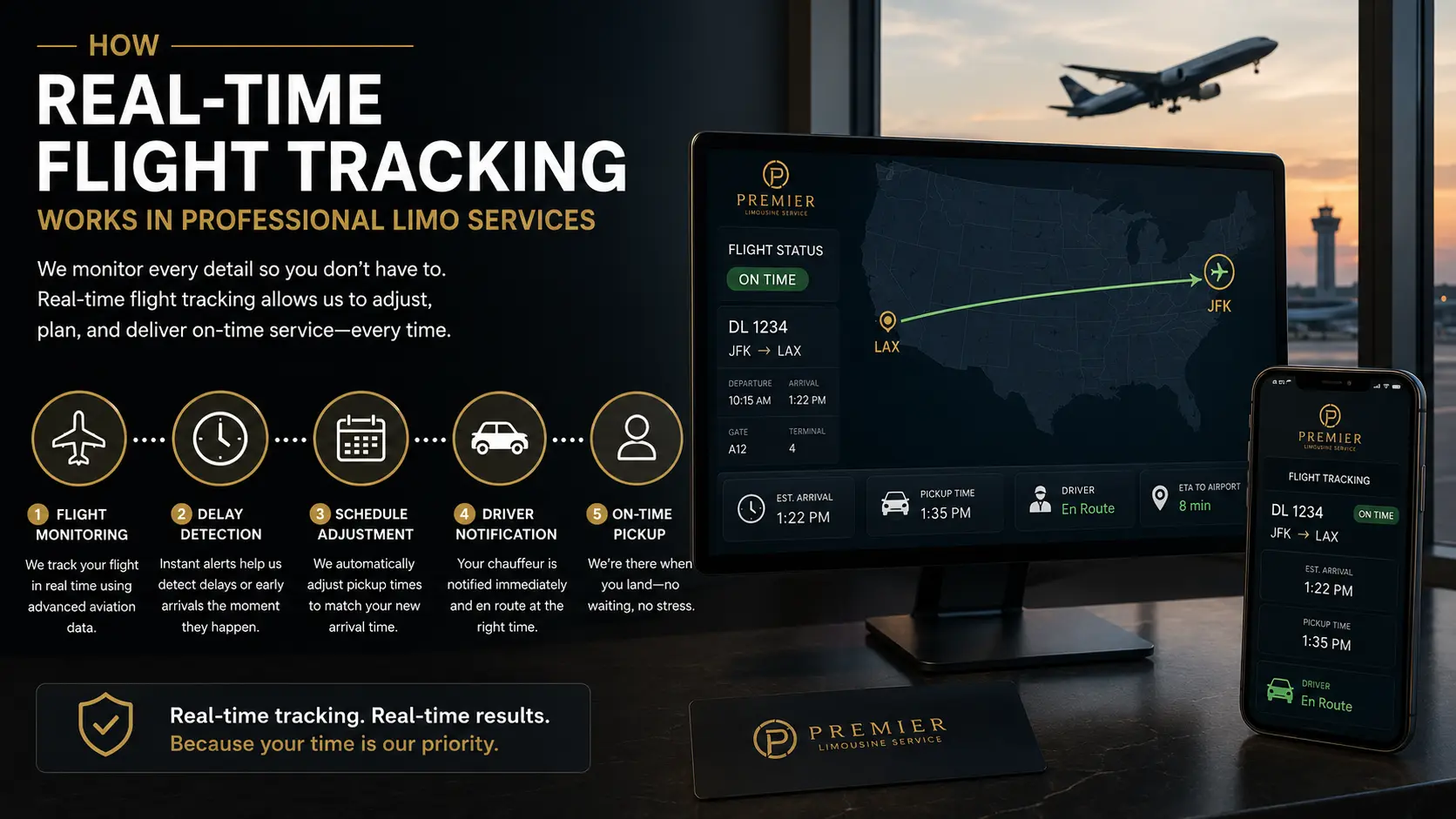
Professional limo services use automated flight monitoring software, powered by aviation data platforms like FlightAware and FlightStats, to track your flight from the moment it departs its origin airport to the second it touches down at its destination. When you provide your airline name and flight number at booking, that information is fed into a dispatch system that continuously pulls live updates on departure times, arrival estimates, gate assignments, and terminal changes.
If your flight is delayed by two hours, your chauffeur is notified and repositioned automatically. If you land 30 minutes early, the system catches that too. You never have to make a single phone call.For travelers using limo service in Aurora, IL for airport transfers to O’Hare International Airport or Midway International Airport, this single feature is often what separates a smooth, stress-free journey from one that starts with a frantic search for a ride while standing at the baggage carousel.
Why Airport Pickup Is Far More Complex Than Most People Realize
There is a common assumption that booking a ride to the airport is straightforward. You land, your driver shows up, and off you go. The reality at a hub like O’Hare International Airport, which handles hundreds of arriving flights daily across five terminals, is considerably more complicated.
Flight delays at O’Hare do not always announce themselves hours in advance. Air traffic control holds, weather systems moving through the Chicago metro corridor, mechanical issues discovered at the origin airport, and cascading delays from earlier flights in a carrier’s schedule can push your actual arrival anywhere from 20 minutes to several hours past your originally scheduled landing time. Gate changes at Terminal 1, Terminal 2, Terminal 3, and International Terminal 5 happen regularly, often without adequate notice to passengers who are still in the air.
A driver showing up at the time printed on your original booking confirmation is not serving you. He is serving a schedule that may no longer match reality. The entire value of real-time flight tracking is that it replaces the static printed schedule with a living, constantly updated picture of where your plane actually is.
The Technology Behind Real-Time Flight Monitoring
Professional limo dispatch systems do not simply check an airline website once before your pickup. They integrate directly with aviation data providers that aggregate flight information from multiple sources, including the Federal Aviation Administration (FAA), airline operational systems, and radar network data.
Two of the most widely used platforms in the ground transportation industry are FlightAware and FlightStats, a service operated by Cirium. These platforms offer commercial API access, meaning limo software companies can plug directly into a live feed of global flight data and have that information automatically update every booking in their dispatch system.
When a limo company like the one serving Aurora, IL enters your flight details at the time of reservation, here is what that integration actually does:
The reservation management system, platforms like Limo Anywhere are common in the professional chauffeur industry, takes the departure airport code, the airline identifier, and the flight number and links that booking to a live data stream. From that point forward, every status change the airline reports, including wheels-up from the origin airport, estimated arrival time revisions, gate reassignments, and actual wheels-down confirmation at the destination airport, flows into the dispatch dashboard automatically.
The dispatch team does not need to check on your flight every 20 minutes manually. The software does it continuously, and when a meaningful change occurs, the system flags it and, in many configurations, automatically recalculates the chauffeur’s departure time or staging position based on the new arrival estimate plus a customizable offset window.
What an Offset Window Means and Why It Matters
One of the more specific details of how professional flight tracking works is the concept of an offset window, sometimes called a pickup offset. This is a pre-set buffer between when your flight gates at the terminal and when your chauffeur is scheduled to arrive at the pickup point.
At a busy airport like O’Hare, the time between when your aircraft docks at the gate and when you realistically walk out of the terminal with your bags in hand can vary considerably. A domestic passenger on a short flight with only a carry-on might exit in 10 minutes. An international traveler arriving at Terminal 5 who needs to clear U.S. Customs and Border Protection, collect checked luggage, and navigate the airport can easily take 45 minutes to an hour or more.
Professional limo services build this knowledge into the tracking system. When your flight gates, the clock on your pickup starts, and the chauffeur is dispatched to the arrival area at a time calculated to have the vehicle ready the moment you walk out, not 25 minutes before you could possibly appear, and not five minutes after you have already been waiting at the curb.
For O’Hare specifically, domestic arrivals at Terminals 1, 2, and 3 typically move faster through the terminal than international arrivals at Terminal 5. A well-configured limo dispatch system accounts for that difference by applying a different offset depending on which terminal your flight is arriving at and whether you are on a domestic or international itinerary.
What Happens at the Dispatch Level When Your Flight Changes
The flight tracking software handles data collection. What turns that data into a seamless pickup experience is what happens at the dispatch level when the system registers a change.
When a significant delay is detected, such as a flight that was expected at 7:30 PM now showing an estimated arrival of 9:45 PM, the dispatch platform alerts the team. A professional dispatcher does not simply wait for the automated system to reschedule the chauffeur. He verifies the update, checks whether there are any other flights in the dispatch queue that might be affected by the same weather system or air traffic condition, and contacts the chauffeur assigned to your booking with updated instructions.
The chauffeur, who may have been preparing to leave for the airport at a specific time, is now redirected. Instead of staging early and accumulating unnecessary wait time in the commercial vehicle holding area, he departs at a recalculated time that puts him at the terminal as your delayed flight arrives. The holding area at O’Hare, where commercial vehicles wait when they arrive before their passenger is ready, is approximately a 5 to 10 minute drive from the terminal buildings. A professional dispatcher uses that geography strategically, positioning the chauffeur close enough to move quickly without burning time idling.
This is the layer that pure technology cannot replace. Automated systems handle the data. Human dispatch teams handle the judgment calls, the coordination between multiple overlapping pickups, and the communication with the chauffeur on the ground.
Early Arrivals Are Tracked Too, Not Just Delays
Most people think about flight tracking in the context of delays, and understandably so. But the system works in both directions, and early arrivals create their own logistical challenge that professional limo services manage with the same technology.
If your flight out of Los Angeles was scheduled to arrive at Midway International Airport at 8:15 PM but catches a tailwind and touches down at 7:40 PM, a basic car service or rideshare app has no idea. The driver shows up at 8:30 PM per the original booking, finds you have been waiting 50 minutes, and neither party is happy.
A dispatch system monitoring your flight in real time captures the early arrival the moment the airline updates the estimated time of arrival. The chauffeur is notified to move sooner. When that is not possible because the vehicle is still completing an earlier booking, the dispatch team at least has visibility to communicate with you proactively rather than leaving you to wonder where your ride is.
For travelers arriving at Midway International Airport from the Aurora and Kane County area, this matters because Midway is a considerably more compact airport than O’Hare. Baggage claim and exit to the curb happen faster at Midway, which means the window between landing and your exit from the terminal is shorter. A service that is tracking your actual arrival time rather than your scheduled arrival time is far better positioned to have a vehicle ready at that tighter exit window.
The Meet and Greet Service Connection
Real-time flight tracking and professional meet and greet service are closely linked, and understanding how they work together explains why the airport pickup experience with a limo service feels so different from flagging down a rideshare in the pickup zone.
When you opt for meet and greet service, a professionally dressed representative of the limo company, often the chauffeur directly, enters the arrivals terminal and waits for you at the baggage claim area holding a card or digital sign with your name on it. At O’Hare International Terminal 5, this typically means waiting at Exit A or Exit B after the customs processing area.
The reason meet and greet can be executed reliably is because the tracking system tells the chauffeur precisely when to enter the terminal. Walking into baggage claim 45 minutes before your flight gates would mean a long wait. Walking in after you have already cleared customs and are standing confused at the exit creates a bad experience. The flight data stream tells the dispatcher when your aircraft is on the ground, when the gate has been assigned, and approximately how long your specific terminal and terminal type will take for deplaning and customs clearance. The chauffeur enters at the right moment, not too early and not too late.
For business travelers flying into O’Hare from New York, Dallas, or Los Angeles on corporate limo accounts, and for families arriving from international destinations at Terminal 5, this level of precision is not a luxury add-on. It is the entire point of booking a professional chauffeur service rather than figuring it out on your own at the curb.
How This Compares to What Uber and Taxi Services Can Offer
It is worth being direct about what rideshare platforms and taxis cannot do in this context, because the gap is meaningful.
When you book an Uber for an airport pickup, you do not actually book a driver in advance. You request a driver when you are ready for pickup, which means the matching process, driver acceptance, and transit to your location all happen after you are already standing somewhere in the airport trying to figure out where the rideshare pickup zone is. There is no chauffeur who has been monitoring your specific flight. There is no dispatch team recalculating a pickup time because your United Airlines connection from Denver ran 40 minutes late. The Uber driver who accepts your request has no prior knowledge of your situation and is simply navigating to the pin you dropped on the map.
At a large and complex airport like O’Hare, where the rideshare pickup areas are separated from the terminal exits and require passengers to navigate to a specific section of the lower level, this lack of coordination creates real friction. During peak arrival windows, the rideshare lots at O’Hare are congested, wait times for driver matches can stretch, and the surge pricing that activates during those congested windows means you are paying more for a less organized experience.
A professionally dispatched limo service has none of those problems because the entire pickup was coordinated before your plane ever left the gate.
What You Should Provide at Booking to Enable Full Flight Tracking
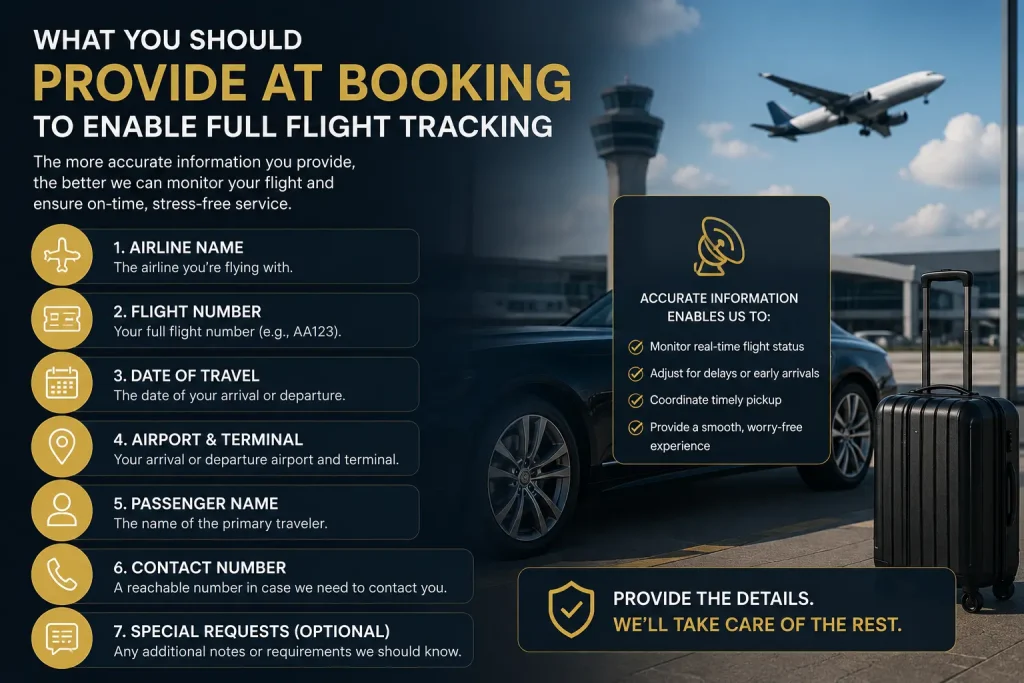
For the system to work correctly, you need to give your limo company accurate flight information at the time of reservation. This typically includes your airline name, your flight number, and the date of travel. Some booking systems also ask for your origin airport, which helps the software identify your specific flight in cases where an airline number is shared across multiple routes or operated by a regional carrier under a different tail.
What you do not need to do is call the company if your flight gets delayed. That is the entire point of the automated tracking system. The software catches the delay, the dispatch team responds to it, and the chauffeur adjusts accordingly. Your job is to get off the plane, collect your belongings, and follow the plan your driver communicates to you via text message when you land.
Most professional limo services send a notification when your flight is on the ground and when your driver is in position. That simple text message, confirming that your ride is ready and telling you exactly where to go, is the result of everything described above working correctly in the background.
Why This Matters Specifically for Aurora IL Airport Travelers
Aurora, IL sits roughly 34 to 38 miles from O’Hare International Airport, depending on your exact address in Kane County or DuPage County. That distance, combined with the Chicago area’s well-documented traffic patterns on the I-88 Tollway, I-290, and I-90, means that a chauffeur who departs at the wrong time faces real consequences. Too early, and he sits in the holding lot burning time. Too late, and he is stuck in congestion while you are already waiting curbside.
The flight-tracking system allows a professional Aurora limo service to calculate your departure from the staging area with precision, accounting for both your actual landing time and real-time traffic conditions along the route between Aurora and the airport. The result is a pickup that feels effortless from your perspective, even though a meaningful amount of coordination happened behind the scenes to make it that way.
At Limo Service Aurora IL, every airport transfer to O’Hare and Midway includes flight monitoring as a standard part of the booking. You provide your flight number, and from that moment forward, your chauffeur stays connected to your actual travel situation rather than the schedule you hoped would hold when you originally booked. Call us at 929-242-6868 or book online to arrange your next airport transfer.