
If you’ve never booked a limo before, the process can feel overwhelming. Which vehicle do you pick? How far in advance should you reserve? What’s actually included in the price? Living in Aurora, IL, you have options — but not all limo services are equal, and the wrong choice can turn a special occasion into a stressful memory.
This guide cuts through the confusion. Whether you need an airport transfer to O’Hare, a stretch limo for prom night, or a party bus for a bachelorette celebration, here’s everything you need to know about booking limo service in Aurora, IL in 2026.
Most people assume limousines are reserved for weddings and proms. In reality, a growing number of Aurora residents use professional car service for practical reasons: avoiding expensive airport parking, arriving at business meetings relaxed and on time, or simply not wanting to deal with downtown Chicago traffic on a night out.
When you factor in parking costs at O’Hare (which can run $30–$50 per day), surge pricing on rideshare apps, and the stress of navigating I-88 during rush hour, a flat-rate limo service to the airport often makes more financial sense than people realize.
Before booking, it helps to understand what type of service fits your situation. Here’s a breakdown of the most common options:
This is the most straightforward booking: a professional chauffeur picks you up at your home or hotel and drives you directly to O’Hare International Airport (ORD) or Midway International Airport (MDW). The best services include real-time flight tracking, so if your return flight is delayed, your driver adjusts automatically — no frantic calls, no rebooking.
With Limo Service Aurorail, airport transfers come with flat-rate pricing, a meet-and-greet at baggage claim, and free cancellation. The GMC Yukon Denali works great for solo travelers or small families, while the Mercedes-Benz Sprinter (12–14 passengers) handles groups arriving together.
Aurora has some beautiful wedding venues — from Fox Valley Country Club to the Gaslite Manor — and getting your bridal party there on time requires more than a couple of Ubers. A stretch limousine or Hummer H2 Stretch handles groups of 14–18 guests, arrives decorated, and gives the wedding party a moment to breathe (and celebrate) before the ceremony begins.
Business travelers flying in and out of O’Hare regularly understand the value of a reliable black car. A clean vehicle, a professional driver who knows the routes, and no surprise pricing — that’s what corporate clients need. Our Lincoln MKT Stretch accommodates 8–10 passengers, making it ideal for executive team transfers.
Prom season in Kane County fills up fast — especially April through June. If your student is attending prom at a local high school, booking early (ideally 6–8 weeks in advance) is essential. All chauffeurs are background-checked and experienced with prom-night logistics.
For larger groups celebrating birthdays, bachelorette parties, or bar crawls through the Fox Valley, a party bus changes the entire dynamic of the night. With seating for 20–30 passengers, premium sound, and the freedom to make multiple stops without hunting for parking, it’s the most practical option for groups that want to stay together.
Choosing the right vehicle depends on your group size, occasion, and budget. Here’s a quick reference:
| Vehicle | Passengers | Best For | Starting Price |
| GMC Yukon Denali | Up to 7 | Airport transfers, small groups | $200 |
| Lincoln MKT Stretch | 8–10 | Weddings, corporate, date nights | $250 |
| Mercedes-Benz Sprinter | 12–14 | Group airport runs, corporate shuttles | $275 |
| Hummer H2 Stretch | 14–18 | Prom, bachelorette, milestone events | $350 |
| Infiniti Stretch | 14–18 | Weddings, anniversaries, VIP events | $350 |
| Party Bus | 20–30 | Large celebrations, bar hops, proms | $450 |
Every vehicle comes with complimentary water, a premium sound system, phone charger ports, leather seating, and a professionally dressed chauffeur.
Booking is simpler than most people expect. Here’s how it typically works:
Step 1 — Know your details. Have your pickup address, drop-off destination, date, time, and approximate group size ready before you call or book online.
Step 2 — Choose your vehicle. Use the list above as a starting point. If you’re unsure, the team at Limo Service Aurorail can help you match the right vehicle to your group size and occasion.
Step 3 — Confirm pricing upfront. Always ask for flat-rate pricing. Reputable limo companies in Aurora will give you a confirmed price before you commit — no surge charges, no hidden fees.
Step 4 — Book early. For weddings and prom, book 6–8 weeks ahead. For airport transfers, 48–72 hours is usually fine, though same-day bookings are sometimes available.
Step 5 — Confirm 24 hours before. A good service will reach out to confirm details the day before. If they don’t, call to verify — especially for early-morning airport runs.
To book with Limo Service Aurorail, call +1 331-204-3950 any time — the line runs 24/7.
Limo pricing in Aurora depends on three main factors: vehicle type, duration, and occasion. Here’s a realistic overview:
Airport transfers are typically flat-rate. O’Hare runs from Aurora (roughly 40 miles via I-88) start around $150–$200 for a sedan or SUV. Midway Airport is approximately 45 miles and slightly more due to traffic patterns on I-55.
Hourly bookings for events and nights out generally require a 2–3 hour minimum. Stretch limousines run $150–$350 per hour; party buses run $300–$450 per hour depending on size and day of the week.
Weekends and holidays cost more — typically 15–25% above weekday rates. If your event falls on a Saturday night in May or June, expect premium pricing across all Aurora limo companies.
One tip that saves people money: book during off-peak hours or on weeknights when possible. A Friday afternoon airport transfer will almost always be cheaper than a Friday evening party pickup.
With several limo companies serving the Aurora area, here’s what actually separates a great experience from a frustrating one:
Licensed and insured chauffeurs. This is non-negotiable. Every driver should be commercially licensed, background-checked, and professionally trained — not a side-hustle driver using a personal vehicle.
Flat-rate pricing. Avoid any company that won’t commit to a price upfront. Hidden fees — fuel surcharges, gratuity “requirements,” minimum booking extensions — are red flags.
Real-time flight tracking. For airport pickups specifically, your driver should know when your flight lands without you having to text them. If a company doesn’t offer flight monitoring, you’re taking on the stress of coordination yourself.
A modern, maintained fleet. Ask about the model year of the vehicle you’re booking. A 2015 stretch limo is a different experience than a 2023 one.
24/7 availability. Flights don’t only land at 2 PM. Neither should your limo service.
The best limo service in Aurora, IL isn’t necessarily the cheapest — it’s the one that shows up on time, puts a professional behind the wheel, and delivers exactly what was promised at booking. Whether you’re heading to O’Hare at 4 AM or celebrating a milestone event in the Fox Valley, the right limo company removes the stress so you can focus on what actually matters.
Ready to book? Call Limo Service Aurorail at +1 331-204-3950 — available 24 hours a day, 7 days a week. Tell us your date, destination, and group size, and we’ll handle everything else.
For airport transfers, 24–48 hours is usually sufficient. For weddings, proms, and large events, book 4–8 weeks in advance — sometimes longer during peak season (April through June and December).
It depends on the company. At Limo Service Aurorail, gratuity is not automatically added — it’s left to your discretion based on the quality of service. A 15–20% tip is standard for excellent service.
Absolutely. This is one of the most common bookings. Your chauffeur will meet you at baggage claim with a name sign, assist with luggage, and take you directly home on a flat rate — no metered surprises.
With real-time flight tracking, your chauffeur adjusts the pickup time automatically. You won’t be charged waiting time for flight delays — that’s part of the service.
Yes. Hourly bookings are available for point-to-point rides, errands, or as-directed service within the Fox Valley area. Call +1 331-204-3950 to discuss your specific needs.
How Early Should You Leave Aurora for O’Hare? If you are leaving Aurora and heading to Chicago O’Hare International Airport, the best answer is to leave at least 2 hours before your flight for most domestic trips. For busy travel days, rush hour traffic, international flights, or winter conditions, you should aim to leave 2.5 to 3 hours early. This timing is not random. It helps you cover the real-world parts of the trip like driving time from Aurora, possible slowdowns on I-88, I-294, and nearby routes, parking, terminal walking distance, airline check-in, and security screening at the airport.
Planning early is one of the easiest ways to reduce stress. It also gives you flexibility if something changes during your trip. Maybe traffic slows down near the interchange. Maybe parking is full for a short time. Maybe your terminal has longer security lines than usual. Leaving with extra time helps you handle those moments without feeling rushed. That is the goal for every traveler from Aurora to O’Hare.
The distance from Aurora to O’Hare is one thing, but the driving experience is another. Your trip can look simple on a map and still feel unpredictable on the road. The airport day usually includes more than just getting there. You also need to plan for how long it takes to park, walk, check your bags, and get through airport security.
On many weekdays, traffic patterns can get heavy around commuting hours. This can happen as you move from Aurora into the broader Chicago area. Routes like I-88 and I-294 are common corridors for reaching O’Hare. When traffic builds, even a small delay can grow into a bigger problem if you already scheduled arrival too close to your flight.
Security is another big reason to leave early. Even if you arrive on time to the terminal, long lines can slow your progress. This is especially true during peak periods when many flights depart around the same time. If you are checking bags, you also add time at the airline counter or bag drop area.
So the main reason you should leave early is that the airport timeline is not one straight line. It is several steps working in sequence. If one step takes longer than expected, the rest of your plan needs cushion.
A clear departure rule can make decision-making easier. Here is a practical approach that works for many people traveling from Aurora to O’Hare. For most domestic flights, leaving 2 hours early is usually enough. This gives time for typical traffic and standard airport processes. For domestic flights during peak travel periods, consider leaving 2.5 hours early. Peak travel periods often include weekday mornings, late afternoons, and major holiday seasons.
For international flights, it is smart to leave about 3 hours early. International travel usually includes additional screening steps and extra time for check-in.If you are traveling with children, older adults, or you are carrying a lot of luggage, add a little more time. Families and groups often move more slowly through check-in, security, and walking to the gate.
When you search for travel timing advice, many competitor pages follow a few shared patterns. They tend to focus on “leave 2 hours early” as a general rule. They also often mention traffic and security lines as the key reasons the rule exists. Many pages repeat that airports are stressful because arrival time is not the same as boarding time.
First, it explains the logic. The reader is not just told a number. They understand why the number works.
Second, it uses real-time factors. Competitor articles commonly mention busy times, weather, and the possibility of slower security during certain hours.
Third, it offers a simple plan. Many pages provide checklists or a short schedule like when to park, when to be at security, and when to start walking to your terminal.
Different travel situations need different buffers. Below are easy scenarios to help you choose your departure time.
If you are leaving Aurora on a weekday morning, you are likely dealing with commuting traffic. In this situation, leaving 2.5 hours early is a safer plan than 2 hours. Rush hour can slow things down in the Chicago metro area. That can affect your entire arrival chain.
Afternoon traffic can also be heavy. People leave work around similar times and traffic can build again before evening. If your flight is later in the day, leaving 2 to 2.5 hours early is often a good range, depending on how crowded your route feels.
Chicago weather can turn a smooth drive into a slow one. Snow and ice can add time and make driving more cautious. If you are traveling in winter, it is smart to leave closer to 3 hours early for domestic flights, especially if roads look slippery. Also consider that parking lots and walkways may take longer if visibility is reduced.
When many people are traveling at once, security lines and check-in areas can become crowded quickly. During holidays, leaving 2.5 to 3 hours early helps you avoid the “arrive late and panic” moment.
If you need to check bags, your timeline includes extra steps. You might need airline counter time, bag tagging, and additional movement inside the terminal. When checking bags, plan for the longer path and keep the buffer.
This checklist turns your plan into clear steps. Use it the next time you travel.
Decide your leave time based on domestic or international and the time of day. A good starting point is 2 hours before for domestic, 2.5 for peak, and 3 for international.
Driving time can change. Even if a GPS estimate says 45 minutes, build in extra time for traffic. Chicago metro traffic can shift quickly, especially around key highways.
At O’Hare, parking can affect your walking time and whether you need shuttles. If you are using a parking option near the terminals, you may walk more directly. If you are parked farther away, you may add shuttle time. It is worth leaving earlier so you do not lose time right before security.
You should not treat security as the moment you start your real schedule. Your goal is to be at security early enough to deal with lines and ticket checks. If your flight is soon, this step can be the difference between relaxed and rushed.
After security, you still need time to find your gate and settle. Some terminals involve longer walking routes. Also, boarding often starts before the last minute, especially for groups and families.
Many people ask whether driving from Aurora is better than using rideshare or transit. The best choice depends on your comfort and schedule, but your departure timing should still include a buffer.
If you are driving, you control the route and depart whenever you want. However, you still face traffic and parking time. You may also face sudden changes around highway exits. Driving usually needs more time if you are unfamiliar with parking options or if you plan to park close to your terminal.
If you are using rideshare or a taxi, you may avoid parking searches. Still, you can face delays at curbside drop-off. Traffic around the terminal can be slow during peak times. Another factor is that drop-off and pick-up routines can vary by terminal and airport operations.
If you are using public transit or other methods, plan for transfer time and walking time. Also remember that transit may run on schedules that differ from flight boarding timelines. The safe approach is always to add a buffer even if you use transit.
Leaving too late usually causes a chain reaction. You might arrive at the terminal during peak security moments. If your line is long, you could struggle to get through before boarding begiThen you might worry about whether your airline allows last-minute boarding.
Many airlines still allow boarding until the final close time, but you should never rely on that. Even if you make it, you might feel stressed and have less time to settle in or locate your gate.That is why the “leave early” rule exists. It protects you from the worst-case scenario without requiring you to predict every minute.
If you want the simplest and most stress-free answer, plan to leave Aurora for O’Hare at least 2 hours early for most domestic flights. For rush hour, crowded travel periods, winter weather, or international flights, leave 2.5 to 3 hours early. This approach covers the parts of the trip that do not behave like a predictable timetable.
Travel should feel like a plan, not a last-minute scramble. With a little extra buffer, you arrive with enough time to handle traffic, find parking, clear security, and still enjoy the calm feeling of being ready before boarding.
For most domestic flights, leave 2 hours early. If you are traveling during rush hour, add time and leave 2.5 hours early.
For international flights, leave about 3 hours early from Aurora. This helps you handle longer check-in and screening steps.
For most travelers, 1 hour early is not enough. You could run into traffic, parking time, and security lines. The safer standard is 2 hours for domestic and 3 hours for international.
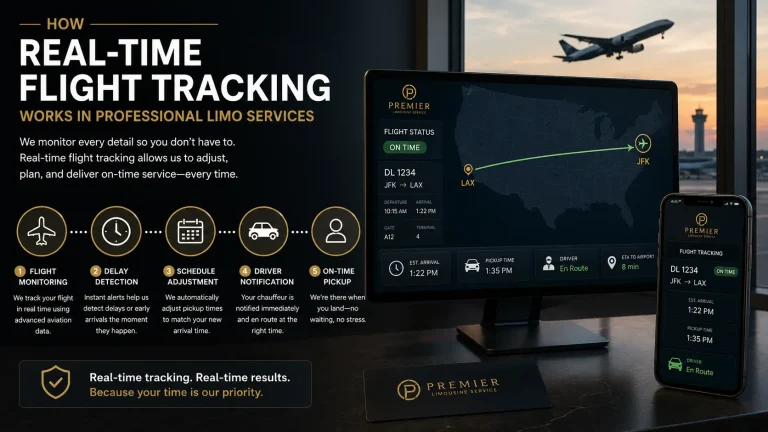
Professional limo services use automated flight monitoring software, powered by aviation data platforms like FlightAware and FlightStats, to track your flight from the moment it departs its origin airport to the second it touches down at its destination. When you provide your airline name and flight number at booking, that information is fed into a dispatch system that continuously pulls live updates on departure times, arrival estimates, gate assignments, and terminal changes.
If your flight is delayed by two hours, your chauffeur is notified and repositioned automatically. If you land 30 minutes early, the system catches that too. You never have to make a single phone call.For travelers using limo service in Aurora, IL for airport transfers to O’Hare International Airport or Midway International Airport, this single feature is often what separates a smooth, stress-free journey from one that starts with a frantic search for a ride while standing at the baggage carousel.
There is a common assumption that booking a ride to the airport is straightforward. You land, your driver shows up, and off you go. The reality at a hub like O’Hare International Airport, which handles hundreds of arriving flights daily across five terminals, is considerably more complicated.
Flight delays at O’Hare do not always announce themselves hours in advance. Air traffic control holds, weather systems moving through the Chicago metro corridor, mechanical issues discovered at the origin airport, and cascading delays from earlier flights in a carrier’s schedule can push your actual arrival anywhere from 20 minutes to several hours past your originally scheduled landing time. Gate changes at Terminal 1, Terminal 2, Terminal 3, and International Terminal 5 happen regularly, often without adequate notice to passengers who are still in the air.
A driver showing up at the time printed on your original booking confirmation is not serving you. He is serving a schedule that may no longer match reality. The entire value of real-time flight tracking is that it replaces the static printed schedule with a living, constantly updated picture of where your plane actually is.
Professional limo dispatch systems do not simply check an airline website once before your pickup. They integrate directly with aviation data providers that aggregate flight information from multiple sources, including the Federal Aviation Administration (FAA), airline operational systems, and radar network data.
Two of the most widely used platforms in the ground transportation industry are FlightAware and FlightStats, a service operated by Cirium. These platforms offer commercial API access, meaning limo software companies can plug directly into a live feed of global flight data and have that information automatically update every booking in their dispatch system.
When a limo company like the one serving Aurora, IL enters your flight details at the time of reservation, here is what that integration actually does:
The reservation management system, platforms like Limo Anywhere are common in the professional chauffeur industry, takes the departure airport code, the airline identifier, and the flight number and links that booking to a live data stream. From that point forward, every status change the airline reports, including wheels-up from the origin airport, estimated arrival time revisions, gate reassignments, and actual wheels-down confirmation at the destination airport, flows into the dispatch dashboard automatically.
The dispatch team does not need to check on your flight every 20 minutes manually. The software does it continuously, and when a meaningful change occurs, the system flags it and, in many configurations, automatically recalculates the chauffeur’s departure time or staging position based on the new arrival estimate plus a customizable offset window.
One of the more specific details of how professional flight tracking works is the concept of an offset window, sometimes called a pickup offset. This is a pre-set buffer between when your flight gates at the terminal and when your chauffeur is scheduled to arrive at the pickup point.
At a busy airport like O’Hare, the time between when your aircraft docks at the gate and when you realistically walk out of the terminal with your bags in hand can vary considerably. A domestic passenger on a short flight with only a carry-on might exit in 10 minutes. An international traveler arriving at Terminal 5 who needs to clear U.S. Customs and Border Protection, collect checked luggage, and navigate the airport can easily take 45 minutes to an hour or more.
Professional limo services build this knowledge into the tracking system. When your flight gates, the clock on your pickup starts, and the chauffeur is dispatched to the arrival area at a time calculated to have the vehicle ready the moment you walk out, not 25 minutes before you could possibly appear, and not five minutes after you have already been waiting at the curb.
For O’Hare specifically, domestic arrivals at Terminals 1, 2, and 3 typically move faster through the terminal than international arrivals at Terminal 5. A well-configured limo dispatch system accounts for that difference by applying a different offset depending on which terminal your flight is arriving at and whether you are on a domestic or international itinerary.
The flight tracking software handles data collection. What turns that data into a seamless pickup experience is what happens at the dispatch level when the system registers a change.
When a significant delay is detected, such as a flight that was expected at 7:30 PM now showing an estimated arrival of 9:45 PM, the dispatch platform alerts the team. A professional dispatcher does not simply wait for the automated system to reschedule the chauffeur. He verifies the update, checks whether there are any other flights in the dispatch queue that might be affected by the same weather system or air traffic condition, and contacts the chauffeur assigned to your booking with updated instructions.
The chauffeur, who may have been preparing to leave for the airport at a specific time, is now redirected. Instead of staging early and accumulating unnecessary wait time in the commercial vehicle holding area, he departs at a recalculated time that puts him at the terminal as your delayed flight arrives. The holding area at O’Hare, where commercial vehicles wait when they arrive before their passenger is ready, is approximately a 5 to 10 minute drive from the terminal buildings. A professional dispatcher uses that geography strategically, positioning the chauffeur close enough to move quickly without burning time idling.
This is the layer that pure technology cannot replace. Automated systems handle the data. Human dispatch teams handle the judgment calls, the coordination between multiple overlapping pickups, and the communication with the chauffeur on the ground.
Most people think about flight tracking in the context of delays, and understandably so. But the system works in both directions, and early arrivals create their own logistical challenge that professional limo services manage with the same technology.
If your flight out of Los Angeles was scheduled to arrive at Midway International Airport at 8:15 PM but catches a tailwind and touches down at 7:40 PM, a basic car service or rideshare app has no idea. The driver shows up at 8:30 PM per the original booking, finds you have been waiting 50 minutes, and neither party is happy.
A dispatch system monitoring your flight in real time captures the early arrival the moment the airline updates the estimated time of arrival. The chauffeur is notified to move sooner. When that is not possible because the vehicle is still completing an earlier booking, the dispatch team at least has visibility to communicate with you proactively rather than leaving you to wonder where your ride is.
For travelers arriving at Midway International Airport from the Aurora and Kane County area, this matters because Midway is a considerably more compact airport than O’Hare. Baggage claim and exit to the curb happen faster at Midway, which means the window between landing and your exit from the terminal is shorter. A service that is tracking your actual arrival time rather than your scheduled arrival time is far better positioned to have a vehicle ready at that tighter exit window.
Real-time flight tracking and professional meet and greet service are closely linked, and understanding how they work together explains why the airport pickup experience with a limo service feels so different from flagging down a rideshare in the pickup zone.
When you opt for meet and greet service, a professionally dressed representative of the limo company, often the chauffeur directly, enters the arrivals terminal and waits for you at the baggage claim area holding a card or digital sign with your name on it. At O’Hare International Terminal 5, this typically means waiting at Exit A or Exit B after the customs processing area.
The reason meet and greet can be executed reliably is because the tracking system tells the chauffeur precisely when to enter the terminal. Walking into baggage claim 45 minutes before your flight gates would mean a long wait. Walking in after you have already cleared customs and are standing confused at the exit creates a bad experience. The flight data stream tells the dispatcher when your aircraft is on the ground, when the gate has been assigned, and approximately how long your specific terminal and terminal type will take for deplaning and customs clearance. The chauffeur enters at the right moment, not too early and not too late.
For business travelers flying into O’Hare from New York, Dallas, or Los Angeles on corporate limo accounts, and for families arriving from international destinations at Terminal 5, this level of precision is not a luxury add-on. It is the entire point of booking a professional chauffeur service rather than figuring it out on your own at the curb.
It is worth being direct about what rideshare platforms and taxis cannot do in this context, because the gap is meaningful.
When you book an Uber for an airport pickup, you do not actually book a driver in advance. You request a driver when you are ready for pickup, which means the matching process, driver acceptance, and transit to your location all happen after you are already standing somewhere in the airport trying to figure out where the rideshare pickup zone is. There is no chauffeur who has been monitoring your specific flight. There is no dispatch team recalculating a pickup time because your United Airlines connection from Denver ran 40 minutes late. The Uber driver who accepts your request has no prior knowledge of your situation and is simply navigating to the pin you dropped on the map.
At a large and complex airport like O’Hare, where the rideshare pickup areas are separated from the terminal exits and require passengers to navigate to a specific section of the lower level, this lack of coordination creates real friction. During peak arrival windows, the rideshare lots at O’Hare are congested, wait times for driver matches can stretch, and the surge pricing that activates during those congested windows means you are paying more for a less organized experience.
A professionally dispatched limo service has none of those problems because the entire pickup was coordinated before your plane ever left the gate.

For the system to work correctly, you need to give your limo company accurate flight information at the time of reservation. This typically includes your airline name, your flight number, and the date of travel. Some booking systems also ask for your origin airport, which helps the software identify your specific flight in cases where an airline number is shared across multiple routes or operated by a regional carrier under a different tail.
What you do not need to do is call the company if your flight gets delayed. That is the entire point of the automated tracking system. The software catches the delay, the dispatch team responds to it, and the chauffeur adjusts accordingly. Your job is to get off the plane, collect your belongings, and follow the plan your driver communicates to you via text message when you land.
Most professional limo services send a notification when your flight is on the ground and when your driver is in position. That simple text message, confirming that your ride is ready and telling you exactly where to go, is the result of everything described above working correctly in the background.
Aurora, IL sits roughly 34 to 38 miles from O’Hare International Airport, depending on your exact address in Kane County or DuPage County. That distance, combined with the Chicago area’s well-documented traffic patterns on the I-88 Tollway, I-290, and I-90, means that a chauffeur who departs at the wrong time faces real consequences. Too early, and he sits in the holding lot burning time. Too late, and he is stuck in congestion while you are already waiting curbside.
The flight-tracking system allows a professional Aurora limo service to calculate your departure from the staging area with precision, accounting for both your actual landing time and real-time traffic conditions along the route between Aurora and the airport. The result is a pickup that feels effortless from your perspective, even though a meaningful amount of coordination happened behind the scenes to make it that way.
At Limo Service Aurora IL, every airport transfer to O’Hare and Midway includes flight monitoring as a standard part of the booking. You provide your flight number, and from that moment forward, your chauffeur stays connected to your actual travel situation rather than the schedule you hoped would hold when you originally booked. Call us at 929-242-6868 or book online to arrange your next airport transfer.